Please find the article created based on the reference content you provided:
Deep Analysis of Sentiment-Index Divergence in HK Stock Oscillation
Keywords: Hong Kong Stocks, Oscillation Divergence, Hang Seng Index, Hang Seng Tech Index, Market Sentiment, External Factors
Introduction
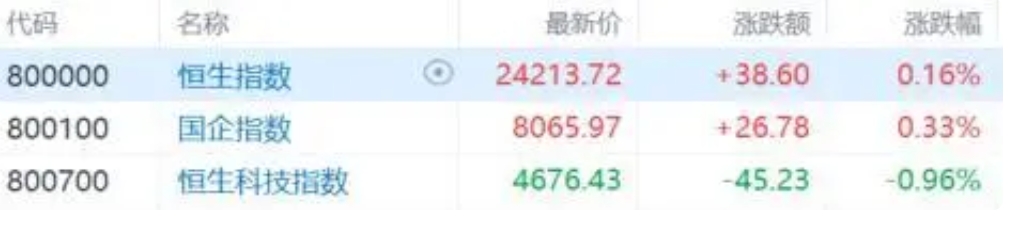
Today's Hong Kong stock market presented a complex picture. The three major indices initially rallied together in early trading, briefly igniting investor enthusiasm. However, the good times did not last; the market quickly reversed and continued to decline, briefly turning all negative intraday. At the final close, the Hang Seng Index and HSCEI managed to hold onto slight gains, rising 0.16% and 0.33%, respectively, while the Hang Seng Tech Index, representing new economy forces, fell 0.96%. This significant divergence not only reveals the split in internal market momentum but also reflects the fragility and insufficiency of bullish sentiment under multiple external pressures.
I. Logic Behind the Divergence: Risk-Off vs. Growth Game
Today's HK stock market trend was essentially a typical intense game between "risk-off sentiment" and "growth preference." The slight rise in the Hang Seng Index and HSCEI was mainly supported by traditional sectors with higher weightings, such as energy, finance, and utilities. These sectors usually have defensive characteristics of high dividends and low valuations, often attracting capital seeking safe havens when market uncertainty increases.
In sharp contrast, the decline in the Hang Seng Tech Index reflects wavering market confidence in high-valuation, high-growth tech stocks. The tech sector is highly sensitive to interest rate environment, regulatory policies, and global risk appetite changes. When overall market sentiment turns pessimistic, these stocks bear the brunt of valuation pressure. This structural divergence is a direct reflection of investors' conservative strategies and pursuit of certainty in the current market environment.

Image description: This chart clearly shows the divergence in today's trends between the Hang Seng Index and the Hang Seng Tech Index, with very different closing results.
II. External Shocks: Linkage Effects with A-Share and Overseas Markets
The reference clearly states that today's HK stock decline "may be affected by external and A-share market drops." This assessment hits the mark. In today's highly interconnected global economy and financial markets, HK stocks, as a highly internationalized market, are easily influenced by the resonance of both internal and external factors.
First, the sharp drop in the A-share market directly impacted the stock prices of mainland companies listed in Hong Kong, especially in tech and consumer sectors. Many companies are dual-listed or highly correlated with the mainland economic cycle, so weakness in A-shares quickly transmits to HK stocks. Second, fluctuations in overseas markets, particularly US stocks, and the release of global macroeconomic data (e.g., inflation, employment) also affect HK stocks through channels like exchange rates and risk appetite. Today's intraday weakness likely accompanies foreign capital outflows or a reassessment of global economic growth prospects.
This linkage means that HK stocks' short-term trends are not entirely determined by domestic fundamentals, but rather drift along in the noisy external environment as part of global risk assets.
III. Market Sentiment: Confidence Recovery Still Needs Time
Although the indices did not show panic-level declines, the internal weakness—"Hang Seng Tech Index fell 0.96%"—and the intraday rally-then-decline trajectory clearly point to one issue: seriously insufficient bullish sentiment.
The technical pattern of a rally followed by a decline is often seen as a signal that bullish forces have launched a tentative attack but failed, then were counterattacked by bears. This indicates that the current market lacks a core logic to continuously attract incremental funds. Whether regarding the pace of macroeconomic recovery or the direction of industry regulation, investors generally adopt a wait-and-see attitude. Additionally, the prolonged previous downturn has consumed considerable market patience, and any disturbance can easily trigger selling. Confidence repair requires not only the consolidation of domestic fundamentals but also the stabilization of the external environment, which is unlikely to be completed in the short term.
Conclusion and Outlook
In summary, today's divergent HK stock market is the result of internal sector structure games combined with external macro environment shocks. The slight rise in the Hang Seng and HSCEI carries obvious defensive undertones, while the tech index decline more truly reflects current market risk appetite and fragile confidence.
Looking ahead, HK stocks are likely to maintain an oscillation pattern in the short term. Investors need to pay close attention to two major variables: first, the actual implementation effects of domestic economic policies and the fulfillment of recovery signals; second, the monetary policy direction of major central banks like the Fed and its impact on liquidity. Until the trend becomes clear, the market will likely continue to swing back and forth between "bottoming" and "waiting," with structural opportunities and challenges coexisting for a long time. For investors, capturing certainty amid uncertainty may be more important than chasing short-term fluctuations.