


On August 7, Hong Kong's three major indices closed higher: the Hang Seng Index rose 0.54%, the HSCEI rose 0.39%, and the Hang Seng Tech Index rose 0.78%, with market sentiment clearly recovering. Innovative drugs, semiconductors, PCB and other technology growth sectors strengthened across the board; Zhipu surged over 14%, and WuXi Biologics rose over 10%. However, amid the broad rally, the agriculture sector was notably conspicuous—dairy stocks led the market decline, Modern Dairy fell over 6% in a single day, Mengniu Dairy dropped over 2%, and agriculture stocks weakened overall, forming a sharp contrast with the hot market.
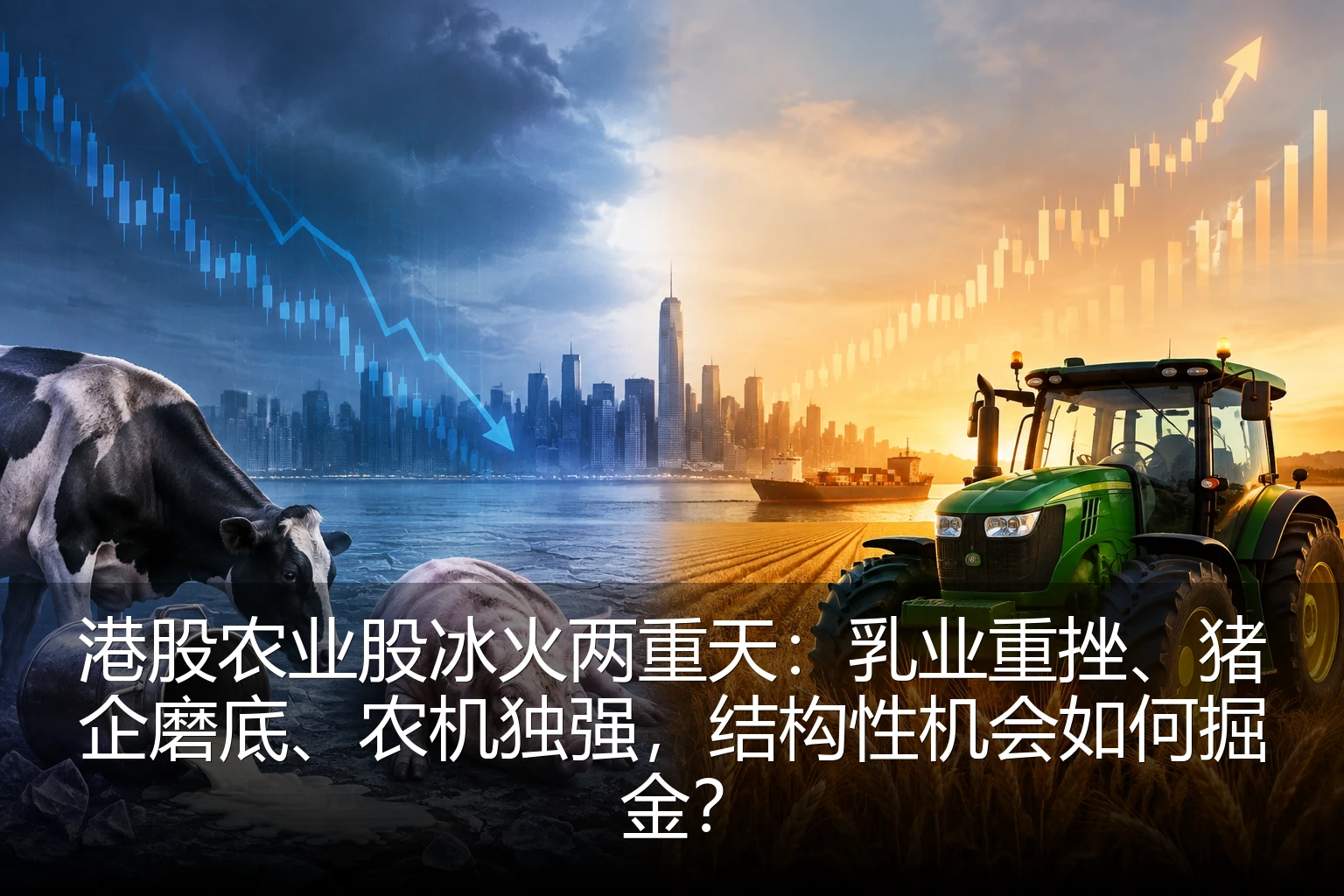
This scene precisely reflects the two extremes structural pattern in the current HK agriculture sector: hog farming is mired in losses, dairy is hit by supply-demand imbalance, while agricultural machinery rises against the trend led by First Tractor. For investors focused on the HK agriculture track, understanding the logic behind this divergence may be more important than chasing index movements.
1. Why are dairy stocks collectively weakening?
The agriculture stocks with the biggest declines today were concentrated in the dairy segment. Modern Dairy closed at HK$1.475, down nearly 7%; Youran Dairy fell over 5%; Mengniu Dairy fell 2.41% to HK$18.61, with a large sell order of 1.4 million shares at the end of the session; China Feihe, AustAsia Group and others also followed lower. In the previous trading day (August 6), Modern Dairy had already plunged 8.38%, bringing the two-day cumulative decline to over 14%, a very brutal performance.
Behind the sharp drop in dairy stocks is continued pressure on industry fundamentals. Since 2025, domestic raw milk prices have entered a downward cycle, with upstream ranch capacity oversupply, weak downstream demand, and high spray-dried powder inventories, sharply compressing profit margins for dairy and ranching companies. As a leading upstream ranching company, Modern Dairy's share price directly reflects the market's pessimistic expectation of when raw milk prices will bottom. Mengniu Dairy, as a midstream giant in the supply chain, also faces dual pressure from slowing terminal sales and rising expenses.
Institutions generally believe that rebalancing dairy supply and demand will take time. Against the backdrop of slow consumer confidence recovery, the dairy industry is unlikely to see a turning point in the short term. Although sector valuations have fallen, the earnings bottom has yet to be confirmed. For investors, left-side positioning in dairy stocks requires more patience and precise judgment of the industry's clearing pace.
2. Pig prices fall below cost line, pig enterprises struggle to survive
Also as sluggish as dairy was the hog farming sector. On August 4, HK-listed pork concept stocks fell collectively: Dekon Agriculture fell 3.6%, Muyuan Foods fell over 3%, COFCO Joycome fell 1.8%, and WH Group also followed lower. At that time, the national average ex-farm price of three-way hybrid hogs had fallen to around RMB 10.32/kg, continuously operating below the industry average cost line, with farming enterprises bleeding on every hog sold.
The transmission effect of low pig prices is being concentrated in interim results. COFCO Joycome previously issued a profit warning, expecting a loss attributable to owners before fair value adjustment of biological assets of approximately RMB 1.0-1.2 billion for the first half of 2026, versus a profit of approximately RMB 198 million in the same period of 2025, turning from profit to loss year-on-year; its share price has fallen nearly 30% year-to-date. Muyuan Foods' H-shares are also oscillating and bottoming under cost-line pressure. Institutions pointed out that the concentrated release of deferred hog supply and secondary fattening may further intensify supply pressure in the second half.
However, pig enterprises are also actively saving themselves. Dekon Agriculture recently announced plans to issue US$100 million zero-coupon convertible bonds at a premium, proactively optimizing its financial structure; after the announcement, its share price once surged over 5%. This time-for-space financing arrangement reflects the determination of leading enterprises to get through the cycle bottom. Multiple brokerage research reports believe that hog capacity reduction is progressing; although pig prices are still bottoming, expectations of a cyclical reversal are accumulating, and the left-side allocation value of the sector is gradually emerging.
3. Agricultural machinery stands out: First Tractor rises 30% in a month
In the context of broad declines in agriculture stocks, the agricultural machinery track is uniquely prosperous. First Tractor (00038.HK) has risen more than 30% cumulatively this month, and gained over 5% again on August 7 to around HK$9.07, with significantly expanded turnover. The logic behind its strength lies in two points: first, agricultural machinery export sentiment is expected to improve marginally, with overseas market expansion opening a second growth curve; second, Goldman Sachs recently initiated coverage on First Tractor with a Buy rating and target price of HK$14, believing the company is well positioned in China's agricultural modernization transformation, able to capture the industry's structural growth opportunities brought by tractor large-sizing and specification upgrades, and has long-term export potential.
From an industrial policy perspective, policies such as agricultural machinery purchase subsidies and scrapping-and-renewal of old machinery continue to be strengthened; coupled with accelerating land transfer and scaled operation, demand for large high-end agricultural machinery is fairly certain. As a leading domestic tractor maker, First Tractor has the dual logic of equipment renewal and export substitution, making it a representative for funds seeking certainty in a weak market.
4. Capital side and strategy: finding the main line amid divergence
Overall, southbound capital recorded a net sell of HK$778 million today, with Shanghai Connect posting net buying of HK$571 million and Shenzhen Connect net selling of HK$1.349 billion, showing a clear internal rotation of funds. The weakening of the agriculture sector contrasts with funds rushing into strong sectors such as technology, pharmaceuticals and copper mines, indicating that the current market exhibits typical structural market characteristics—calm at the index level, but undercurrents between sectors.
Looking ahead, Western Securities believes the US dollar index may be easier to fall than rise, and HK stocks have the foundation for strategic bullish positioning; the center of the AI narrative is shifting from North America to China and from hardware to applications, with a medium-term bullish view on HK internet and technology sectors. Regarding the agriculture sector, institutions generally remind investors to closely watch turning-point signals in pig and milk prices, progress of capacity reduction, and policy support strength, remain patient at the cycle bottom, and wait for the right-side confirmation of prosperity reversal.
5. Investment implications of the HK agriculture sector
From the perspective of why trade HK stocks, the HK agriculture sector offers investors a richer set of choices than A-shares:
- Global leaders gather: For example, WH Group is the world's largest pork food enterprise, with businesses spanning China, the US and Europe. Investors can share in the dividends of the globalized pig supply chain through HK stocks;
- A+H linkage opportunities: Dual-listed targets such as Muyuan Foods and COFCO Joycome facilitate cross-market valuation comparisons. HK-listed relatively undervalued discount instruments often have value-repair opportunities;
- Comprehensive category coverage: From hog farming, dairy and ranching to machinery equipment, seed industry and agricultural materials, the HK agriculture chain covers a full spectrum. Investors can flexibly switch sub-industry allocations based on prosperity;
- Increasingly rich tools: In addition to individual stocks, HK has agriculture-related ETFs, convertible bonds and other instruments. Combined with liquidity support from sustained southbound inflows, operation methods are more diverse.
Of course, agriculture is a typical strongly cyclical industry with violent fluctuations in pig and milk prices, large earnings elasticity and high uncertainty. While seizing structural opportunities, investors also need to be alert to risks such as frequent earnings landmines during cyclical downturns and divergence in individual stock liquidity, reasonably control positions, and diversify allocation.
In summary, the two extremes of the HK agriculture sector on August 7 is both a focused test of industry prosperity and a mirror for observing structural market opportunities. Against the backdrop of moderate index gains, the divergence in the agriculture sector reminds investors: excess returns in HK stock investment often lie in fine-grained comparison and forward-looking positioning within sectors.
