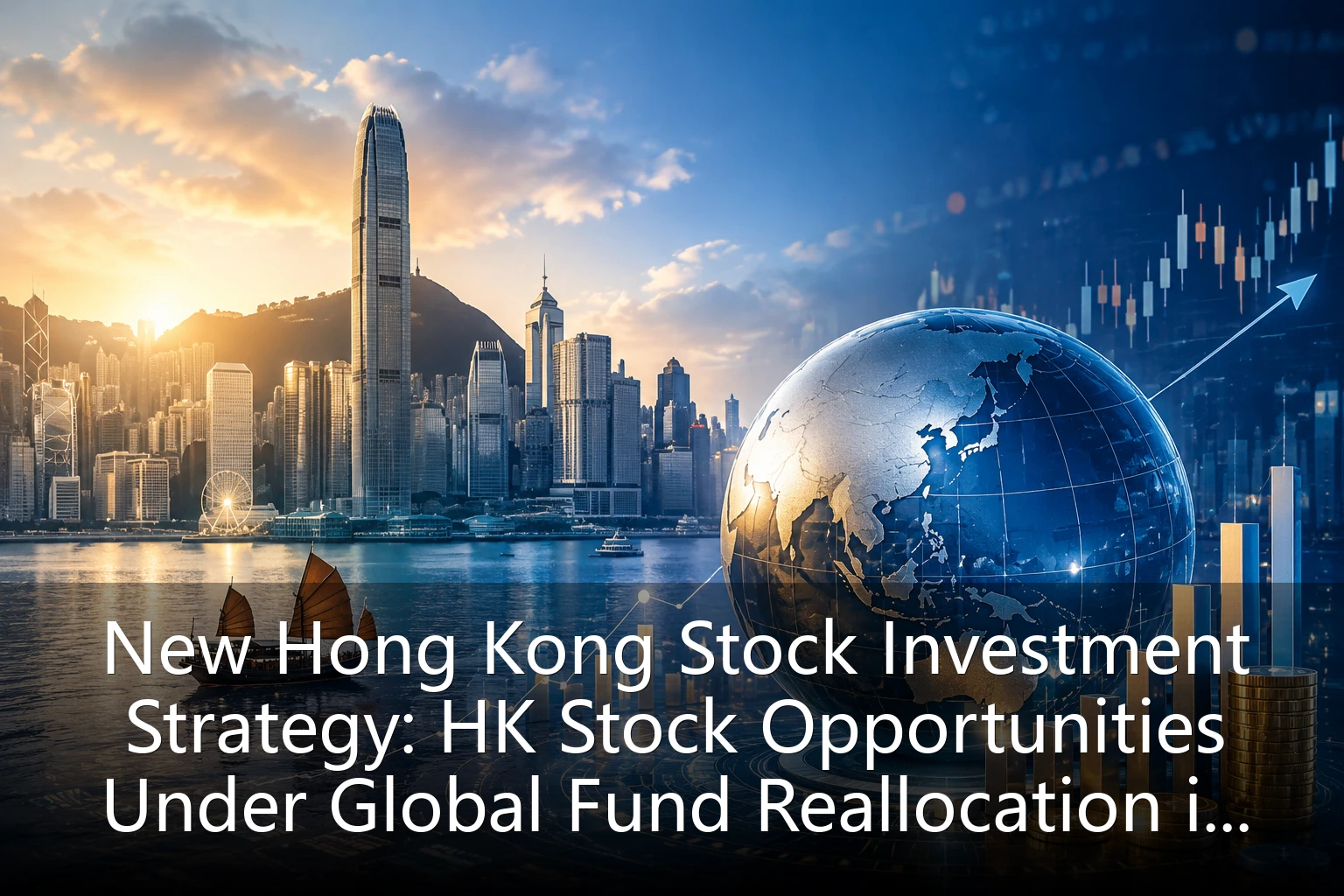
New Hong Kong Stock Investment Strategy: HK Stock Opportunities Under Global Fund Reallocation in the Second Half of 2026
Against the backdrop of profound changes in the global economic landscape, the Hong Kong stock market is ushering in a new round of investment opportunities. As we enter the second half of 2026, the trend of global fund reallocation is becoming increasingly evident. The Hong Kong stock market, with its unique investment value and diversified investment targets, is attracting growing attention from international capital. This article will provide an in-depth analysis of investment strategies in the Hong Kong stock market, helping investors seize this round of investment opportunities.
I. The Hong Kong Stock Market: A Value Haven in the Eyes of Global Capital
Since 2026, the Hong Kong stock market has continued to demonstrate its unique charm as a value haven for global capital. The Hang Seng Index's P/E ratio is less than 10 times, significantly lower than major global markets, providing investors with sufficient safety margin and upside potential. Meanwhile, the AH premium index has continued to widen, showing a clear discount advantage for the Hong Kong market compared to the A-share market, creating good opportunities for cross-market arbitrage.
Data shows that in the first half of 2026, net inflow of southbound funds exceeded 300 billion Hong Kong dollars, setting a new high for the year, a trend that continued in the second half. The accelerated inflow of global funds into the Hong Kong stock market reflects both the confidence of international investors in China's economic prospects and highlights the strategic position of Hong Kong in global asset allocation.
II. Hong Kong Stock Investment Strategy for the Second Half of 2026: Dual-Wheel Drive
In the current market environment, Hong Kong stock investment strategies should adopt a "dual-wheel drive" approach of high dividends and tech growth. This strategy can not only generate stable cash flow returns but also share the growth dividends brought by technological innovation.
1. High Dividend Strategy: A Stable Choice Through Market Cycles
The high dividend strategy is an important allocation direction in the current market environment. Against the backdrop of increasing global economic uncertainty and a declining interest rate cycle, high dividend stocks can provide stable cash flow returns, effectively hedging against market volatility risks. In the Hong Kong stock market, leading stocks in sectors such as finance, energy, and utilities generally have dividend yields of over 5%, with some quality even exceeding 7%, far above the average of major global markets.
Particularly noteworthy is that after the adjustment of Hong Kong Stock Connect eligible stocks, a batch of high-dividend "special valuation" stocks have been included. These companies not only have stable profitability and dividend policies but also benefit from domestic economic recovery and policy support, making them highly valuable investment targets.
2. Tech Growth Strategy: Seizing Innovation Dividends
The technology sector is another important investment direction in the Hong Kong stock market. In 2026, global technological innovation is accelerating, with major breakthroughs in fields such as artificial intelligence, new energy, and biotechnology. The Hong Kong stock market hosts numerous quality technology enterprises, including internet giants, semiconductor companies, and new energy firms, which have strong technological innovation capabilities and global layouts, poised for rapid growth in the coming years.
Specifically, investment in the Hong Kong tech sector should focus on three types of enterprises: first, leading companies with core technological advantages and global competitiveness; second, emerging industry leaders benefiting from domestic industrial policy support; and third, high-growth small and medium-sized tech companies, which although carry higher risks, offer more potential returns.
III. Risks and Responses in Hong Kong Stock Investment
Although the Hong Kong stock market offers many investment advantages, investors should fully recognize the risk factors and take corresponding countermeasures.
1. Exchange Rate Risk Management
One of the main risks in Hong Kong stock investment is exchange rate fluctuation risk. Exchange rate fluctuations between the RMB and HKD affect investors' actual returns. To mitigate this risk, investors can adopt the following strategies: first, hedge through RMB/HKD forward contracts; second, choose RMB-denominated Hong Kong Stock Connect investments to reduce exchange rate impact; third, treat Hong Kong stock investment as part of global asset allocation to reduce single-currency risk through diversification.
2. Policy Risk Response
The Hong Kong stock market is significantly affected by domestic and foreign policies, requiring investors to closely monitor policy changes. On one hand, attention should be paid to the impact of domestic regulatory policies on related industries; on the other hand, the impact of changes in the international political and economic environment on the Hong Kong stock market should also be monitored. Investment decisions should adopt a diversified strategy to avoid excessive concentration in a single industry or region.
IV. Hong Kong Stock Account Opening and Trading Guide
For investors interested in Hong Kong stocks, understanding the account opening process and trading rules is crucial.
1. Account Opening Process
There are two main ways to open a Hong Kong stock account: first, through the Hong Kong Stock Connect channel, suitable for mainland investors; second, directly opening an account with a Hong Kong brokerage, suitable for investors with overseas accounts. Hong Kong Stock Connect account opening is relatively simple - investors only need to activate the relevant permissions with a mainland broker, with a minimum asset threshold of 500,000 RMB.
2. Trading Rules
Hong Kong stock trading differs significantly from A-share trading, and investors need to familiarize themselves with the following rules: first, trading hours - Hong Kong trading is from 9:30-12:00 AM and 1:00-4:00 PM; second, trading units - Hong Kong uses "lots" as trading units, with different numbers of shares per lot for different stocks; third, price limits - Hong Kong has no upper/lower price limits but has a market volatility adjustment mechanism; fourth, trading fees - Hong Kong trading includes multiple fees such as commission, stamp duty, and trading levy, which investors need to fully understand.
V. Conclusion: Outlook for Hong Kong Stock Investment
Looking ahead to the second half of 2026, against the backdrop of global fund reallocation, the Hong Kong stock market is expected to maintain its active momentum. The dual-wheel drive investment strategy of high dividends and tech growth will help investors achieve stable returns in a complex and changing market environment.
For investors, the Hong Kong stock market is not only an important channel for diversifying investment risks but also a key way to share the dividends of China's economic globalization. With the continuous development of China's economy and the ongoing opening of its capital market, the investment value of the Hong Kong stock market will further highlight, providing global investors with more quality investment targets and opportunities.
In the investment process, investors should maintain a rational investment mindset, formulate reasonable investment strategies based on their own risk tolerance and investment goals, and avoid blind following and excessive trading. At the same time, continuous attention should be paid to market dynamics and policy changes, with timely adjustments to investment portfolios to respond to market uncertainties.
In conclusion, as an important global financial center, the investment value of the Hong Kong stock market cannot be ignored. Against the backdrop of profound changes in the global economic landscape, the Hong Kong stock market will provide investors with abundant investment opportunities and broad development space. Seizing Hong Kong stock investment opportunities will be an important topic in global asset allocation for the second half of 2026.