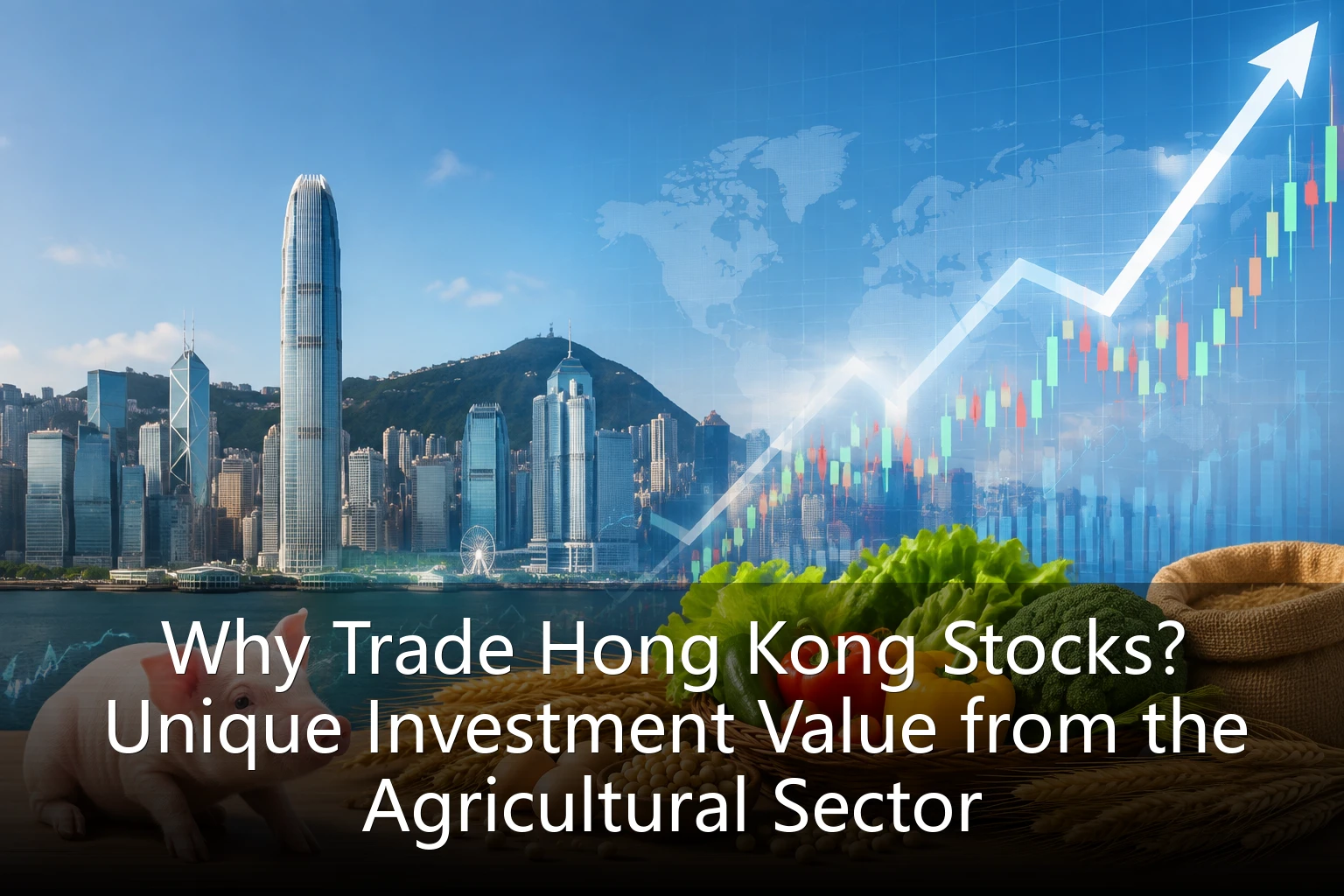
On August 1, 2026, as the HK stock interim reporting season kicked off, the agricultural sector became one of the market's focal points. Against the backdrop of the comprehensive advancement of the rural revitalization strategy in the mainland, moderate rises in agricultural product prices, and accelerated commercialization of biological breeding technology, many HK-listed agricultural stocks issued positive earnings forecasts, driving the sector higher. Many investors are beginning to ask: Why trade HK stocks? What unique appeal does the HK stock market have? This article will take the agricultural sector as a specific perspective and, combined with the latest market dynamics, sort out the logic, operational process and risk boundaries of HK stock investment for investors.
HK Stock Market: An Undervalued Market for Global Capital Allocation
As a bridge connecting mainland China and global capital markets, the Hong Kong stock market has long been known for low valuations, rich product variety and a high degree of internationalization. Compared with A-shares, the overall P/E and P/B ratios of the HK market have remained lower for a long time, with valuation discounts even more pronounced in traditional sectors. Taking agriculture as an example, the average P/E ratio of leading A-share agricultural companies is generally above 30 times, while comparable HK-listed counterparts often trade at only 15-20 times, and some quality stocks even fall below net asset value. This valuation gap stems from multiple factors including market liquidity structure, investor preferences and trading mechanisms, but it also provides a margin of safety for value investors.
Meanwhile, the HK market has many quality companies that are scarce in the A-share market. In agriculture, Hong Kong stocks not only include China's largest feed companies and leading pig farming enterprises, but also a group of innovative companies focused on seed industry, marine ranching and smart agriculture. Leveraging the efficient financing function of the Hong Kong market, these enterprises continue to increase R&D investment and promote agricultural modernization. For mainland investors, they can easily share these growth dividends through Hong Kong Stock Connect or by opening an account directly.
HK Agricultural Sector: Policy Dividends and Industrial Upgrading in Resonance
Agriculture is the ballast of the national economy, and policy support for agriculture has continued to increase in recent years. In the first half of 2026, the Central Document No. 1 once again emphasized accelerating the building of a strong agricultural country and proposed specific measures such as expanding the industrial application of biological breeding and promoting the transformation and upgrading of agricultural product processing. These policies not only benefit A-share agricultural stocks, but also have a significant transmission effect on the HK stock market. Sub-sectors in the HK agricultural sector, including seed, feed, breeding and agricultural product circulation, have all shown varying degrees of activity.
From a fundamental perspective, the global food security situation remains complex. The El Nino phenomenon has disrupted crop yields in some major production areas, and international grain prices remain volatile at high levels. This brings opportunities for companies in the domestic planting industry chain to achieve both volume and price increases. Meanwhile, the reduction of domestic hog production capacity is coming to an end, and pig prices are expected to enter a new upward cycle in the second half of 2026, with the earnings elasticity of pig farming stocks worth anticipating. Leading HK agricultural companies, relying on scale advantages and cost control capabilities, are often able to capture the profit improvement brought by industry turning points earlier.
Technological change is also a driver that cannot be ignored. Frontier technologies such as smart agriculture, precision breeding and unmanned agricultural machinery are reshaping traditional agricultural production methods. The Hong Kong stock market has always been open to technology innovation companies, and many agricultural technology companies have been successfully listed. For example, a gene-edited corn variety developed by a HK-listed company has entered the variety approval stage, and the market has responded enthusiastically. It is foreseeable that more 'agriculture + technology' targets will be listed on the HK stock market in the future, providing investors with scarce allocation choices.
HK Stock Investment Primer: Key Points of Account Opening and Trading Rules
For mainland investors, allocating to HK stocks is not difficult. There are currently two main ways: first, through the Stock Connect schemes (Southbound) under the Shanghai-Hong Kong Stock Connect and the Shenzhen-Hong Kong Stock Connect, investors can directly use their A-share accounts to participate in HK stock trading without opening an additional offshore account, which is convenient; second, investors can open an HK stock account directly with a licensed broker in Hong Kong to trade all HK stocks and derivatives. The first method is suitable for most ordinary investors but requires meeting the RMB 500,000 asset threshold; the second method has a lower threshold and its process is increasingly simplified, with some internet brokers supporting fully online processing.
Regarding trading rules, investors need to note the following:
- Trading hours: HK stocks trade Monday to Friday, 9:30-12:00 and 13:00-16:00, with a pre-opening auction session from 9:00 to 9:30 and a closing auction session (16:00-16:10) after the market closes.
- T+0 round-trip trading: HK stocks support buying and selling on the same day, making capital use more efficient and suitable for short-term traders.
- No daily price limit: HK-listed stocks have no 10% daily price limit, so intraday volatility can be high and risk management needs attention.
- Tick size: The minimum price tick for HK stocks varies by price range; for example, below HK$10 it is HK$0.001, and above HK$100 it is HK$0.05.
- Trading costs: Including commissions, transaction levies, trading fees, stamp duty, etc. The overall cost is slightly higher than A-shares, but the difference is not significant.
In addition, HK stocks implement T+2 settlement, meaning funds and securities are transferred on the second trading day after the transaction. Investors must wait two trading days after selling shares before withdrawing cash.
Practical Strategies for Positioning in HK Agricultural Stocks
For investors bullish on the agricultural sector, the HK market offers a variety of participation tools. Buying individual stocks directly is the most common method, but attention should be focused on the company's core competitiveness, earnings quality and valuation rationality. It is recommended to give priority to leaders in sub-sectors. These companies have stable market share, strong risk resistance, and are more likely to gain favor from institutional funds. For example, in feed and breeding, groups with leading market share often have complete industrial chain integration advantages that can effectively smooth out hog cycle fluctuations.
In addition, HK agricultural ETFs are also a good choice for diversifying risk. In 2026, there are already several ETF products focusing on the agricultural sector, covering agricultural listed companies within the scope of Hong Kong Stock Connect. Through ETF allocation, investors can avoid the risk of individual stock collapses and obtain overall sector returns at a lower cost. For IPO investors, the subscription opportunities for new HK agricultural stocks are also worth attention. However, the risk of new stocks falling below issue price should be noted, and it is recommended to make decisions only after fully studying the prospectus and industry prospects.
In terms of timing, the trends of agricultural product futures have a strong correlation with agricultural stock prices. Tracking changes in futures prices such as soybean meal, corn and live hogs can help judge the direction of upstream costs and downstream demand, thereby capturing the allocation window for agricultural stocks.
Risk Warning: Several Aspects Not to Be Ignored When Trading HK Stocks
Although the HK stock market offers many opportunities, the risks should not be underestimated. First, exchange rate fluctuations affect the actual returns of HKD-denominated assets when converted into RMB. Second, there are differences between the HK market and the mainland market in delisting rules and information disclosure regulation, and some small-cap companies may have governance risks. Third, agriculture itself is greatly affected by uncontrollable factors such as natural conditions and epidemics, with obvious cyclicality. Investors need to fully understand industry fluctuations.
More importantly, the HK stock market has no price limits, and individual stocks may experience sharp single-day declines. If a company encounters an earnings blowup or liquidity crisis, the loss can often exceed expectations. Therefore, investors are advised to set reasonable stop-loss disciplines while controlling positions, and try to choose targets with solid fundamentals and ample liquidity.
In addition, when mainland investors participate through Stock Connect, they should note that the dividend tax policy differs from that of A-shares. Dividends received by individual investors from HK stocks held through Stock Connect are subject to a 20% individual income tax withheld at source. This point deserves special consideration when investing long-term in high-dividend agricultural stocks.
Conclusion: Rational Understanding and Seizing Structural Opportunities in HK Stocks
Returning to the question of 'why trade HK stocks,' the answer is actually not complicated: the HK market provides investors with an investment environment of lower valuations, more choices and greater flexibility. As a field that combines defensive and growth attributes, the agricultural sector is entering a long-term positive development window driven by policy and technology. However, investment is always a game between risk and return, and no market or sector is a sure bet. Investors should assess their own risk tolerance, seriously learn the HK stock rules, and deeply study industry fundamentals to navigate this international capital market steadily and achieve long-term success.
In the future, as financial cooperation in the Guangdong-Hong Kong-Macao Greater Bay Area further deepens and the connectivity mechanism between the mainland and Hong Kong markets continues to improve, the HK stock market will attract more attention from mainland investors. Agriculture, an ancient yet vibrant industry, will also gain new vitality with the help of the capital market. For rational and patient investors, the long-term investment value of the HK agricultural sector is worth looking forward to.