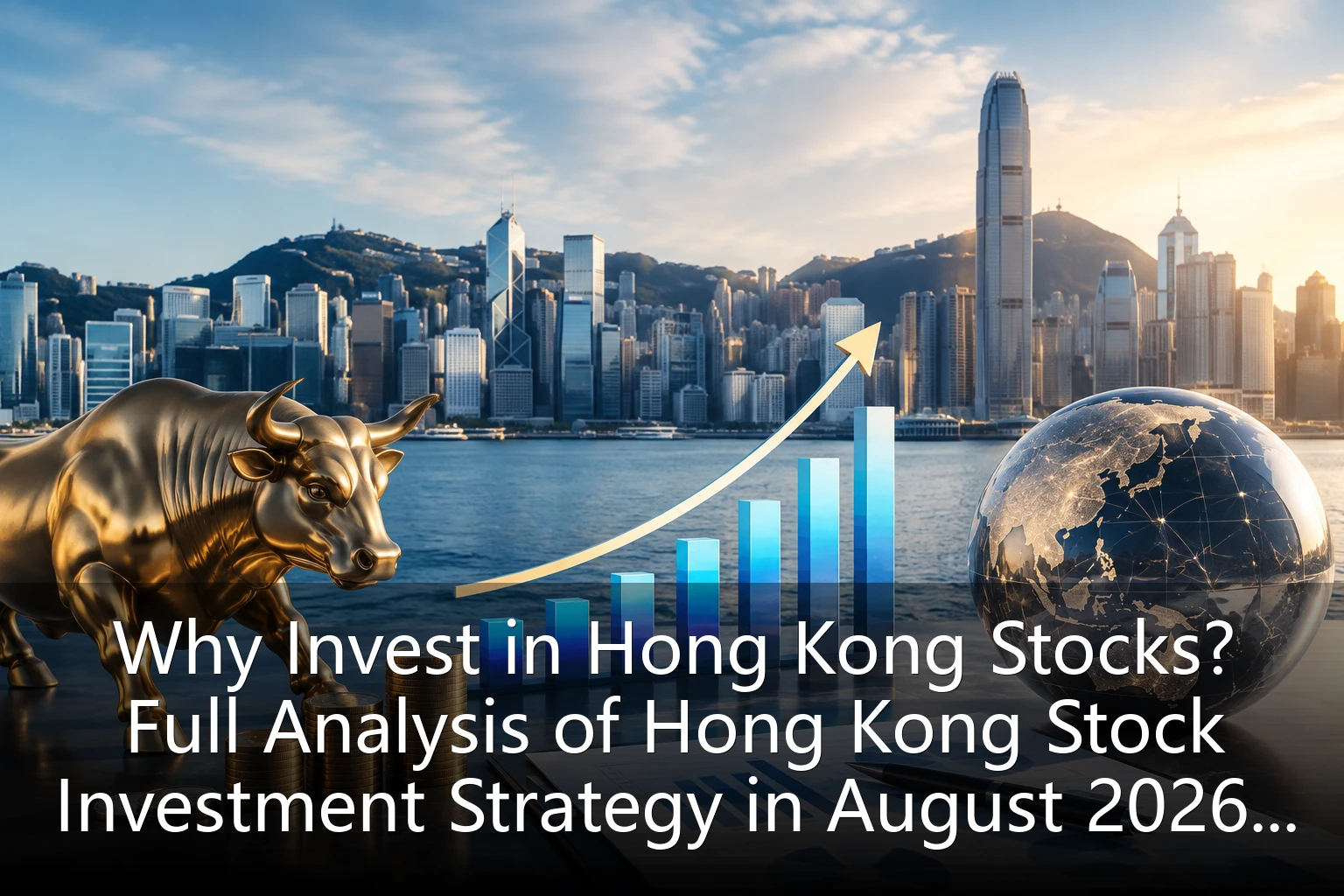
On August 14, 2026, the Hong Kong stock market once again became the focus of global investors. As the Hang Seng Index continues to hover at historical lows, the AH-share premium widens further, and the liquidity easing brought by the global interest rate cut cycle, the valuation bottom effect of Hong Kong stocks becomes increasingly prominent. For mainland investors, investing in Hong Kong stocks not only means sharing the growth dividends of high-quality Chinese concept stocks but also a key step in achieving asset allocation diversification in the current market environment. This article will comprehensively analyze the core advantages, practical strategies, and precautions of Hong Kong stock investment to help investors make rational decisions and seize this round of investment opportunities.
I. Unique Advantages of the Hong Kong Stock Market: Why Is It Worth Investing?
As an important bridge connecting mainland China and global capital, the Hong Kong stock market provides many unique advantages for investors. First, the valuation level of Hong Kong stocks is significantly lower than that of the A-share market. As of August 2026, the price-to-earnings ratio (PE) of the Hang Seng Index is less than 10 times, far lower than the average valuation of A-shares, which means investors can buy high-quality assets at a lower price. For example, many technology, consumer, and financial stocks listed in Hong Kong have a PE ratio of only 60%-70% of their A-share counterparts, providing a higher safety margin for long-term investors.
Second, the widening AH-share premium is an important factor attracting capital to Hong Kong stocks. The AH-share premium refers to the price difference of the same company in the A-share and H-share markets. The higher the premium rate, the cheaper the H-share is relative to the A-share. In August 2026, the average AH-share premium rate has exceeded 40%, and some individual stocks even exceed 100%. This price difference provides opportunities for cross-market arbitrage. Investors can buy H-shares through Hong Kong Stock Connect to enjoy lower valuations than A-shares. For example, a well-known bank stock is priced at 10 yuan in A-shares but only 6 yuan in Hong Kong, with a premium rate of 67%, which obviously provides a clear arbitrage space for investors.
In addition, the high dividend strategy in the Hong Kong stock market is particularly prominent in the current environment. As the global interest rate cut cycle deepens, the returns on fixed-income assets decline, and high-dividend stocks become a safe haven for funds. Many traditional industries in Hong Kong, such as utilities, telecommunications, and financials, have dividend yields generally exceeding 5%, with some even reaching over 8%. These high-dividend stocks not only provide stable cash flow but also offer a certain degree of defensiveness in market volatility. For example, a utility company in Hong Kong has a dividend yield of 6.5%, far higher than the yield of government bonds in the same period, making it an ideal choice for conservative investors.
1.1 Coexistence of Low Valuation and High Growth Potential
The low valuation of Hong Kong stocks does not mean a lack of growth potential. On the contrary, many new economy companies listed in Hong Kong, such as technology, new energy, and biomedicine enterprises, are in a stage of rapid growth. These companies are often difficult to enter the A-share market due to high valuations but trade at reasonable prices in Hong Kong. For example, a new energy vehicle company in Hong Kong has a PE ratio of 15 times, while its revenue growth has exceeded 50% for three consecutive years, showing strong growth momentum. Investors can allocate to these high-growth targets through Hong Kong Stock Connect to share their future returns.
1.2 Signals of Global Capital Inflow
The continuous net inflow of Southbound funds (mainland funds flowing into Hong Kong stocks through Hong Kong Stock Connect) is another important indicator of Hong Kong's attractiveness. In the first half of 2026, the net inflow of Southbound funds exceeded 300 billion Hong Kong dollars, reaching a new high for the year. This shows that mainland investors' confidence in Hong Kong stocks is continuously strengthening. In addition, global institutional investors are also increasing their allocation to Hong Kong stocks, especially high-dividend and "China-specific valuation" concept stocks. For example, an international fund recently significantly increased its holdings of high-dividend Hong Kong stocks, believing they have high attractiveness in the context of global interest rate cuts.
II. Current Market Environment: Global Interest Rate Cuts and Liquidity Easing
In August 2026, major central banks around the world are gradually entering an interest rate cut cycle, with the Federal Reserve, European Central Bank, etc., cutting interest rates to cope with economic slowdown and inflation pressure. This trend brings ample liquidity to the Hong Kong stock market. First, interest rate cuts reduce corporate financing costs, which is conducive to improving company profits. Second, in a low-interest-rate environment, funds are more inclined to flow into high-dividend and growth-oriented assets, and Hong Kong stocks happen to meet this demand.
In addition, fluctuations in the RMB exchange rate also provide opportunities for Hong Kong stock investment. As the RMB depreciates, the relative attractiveness of Hong Kong stocks increases because RMB-denominated Hong Kong assets become cheaper after depreciation. For example, if an investor buys Hong Kong stocks with RMB, and the RMB depreciates by 5%, the value of their Hong Kong assets denominated in RMB will increase by 5%, forming an exchange rate arbitrage opportunity.
2.1 Impact of Federal Reserve Policy
Federal Reserve Chairman Walsh clearly stated in his first speech in July 2026 that he will continue to maintain a loose monetary policy until inflation stabilizes at the 2% target. This statement triggered market expectations of interest rate cuts globally, pushing funds to flow into emerging markets, including Hong Kong. As an important carrier of offshore RMB assets, Hong Kong benefits from this trend. For example, a securities firm analysis pointed out that the Federal Reserve's interest rate cuts will further enhance the valuation level of Hong Kong stocks and attract more international capital inflows.
2.2 Support from Mainland Economic Recovery
The steady recovery of the mainland economy also provides fundamental support for Hong Kong stocks. In the first half of 2026, the mainland's GDP growth reached 5.5%, exceeding market expectations. Consumption, investment, and exports all performed strongly, especially in emerging industries such as new energy vehicles and artificial intelligence. The leading companies in these industries are mostly listed in Hong Kong, and their performance growth will directly drive stock prices upward. For example, a new energy vehicle company had a revenue growth of 60% and a net profit growth of 45% in the first half of 2026, becoming a star stock in the Hong Kong market.
III. Practical Strategies: How to Invest in Hong Kong Stocks?
For mainland investors, investing in Hong Kong stocks is mainly done through Hong Kong Stock Connect. The following is a detailed analysis of the account opening process, trading rules, and risk warnings.
3.1 Account Opening Process
Opening Hong Kong Stock Connect requires meeting certain conditions: First, investors need to have an A-share account with an average daily asset of no less than 500,000 RMB in the previous 20 trading days; second, they need to sign a risk disclosure statement to confirm they have the corresponding risk tolerance. The account opening process usually includes: applying for Hong Kong Stock Connect authority in the securities firm's APP, submitting identity and asset proof, and waiting for the securities firm's approval. The review time is generally 1-3 working days, and after approval, trading can begin.
It should be noted that the trading days of Hong Kong Stock Connect are different from A-shares. Hong Kong trading days are Monday to Friday, 9:30-12:00 AM and 1:00-4:00 PM, while A-shares are 9:30-11:30 AM and 1:00-3:00 PM. In addition, Hong Kong Stock Connect has a daily quota limit. The daily quota for Southbound funds is 10.5 billion yuan. If the quota is exhausted, buying will be suspended on that day.
3.2 Trading Rules and Fees
The trading rules of Hong Kong stocks differ from A-shares: First, Hong Kong implements T+0 trading, meaning stocks bought on the same day can be sold on the same day, while A-shares are T+1. Second, Hong Kong has no price limit, so stock prices may fluctuate greatly, and investors need to pay attention to risks. Third, Hong Kong's trading fees include commissions, stamp duty, and transaction levies, with a total cost of about 0.1%-0.3% of the transaction amount, which is higher than A-shares.
For example, an investor buys 1,000 shares of a stock through Hong Kong Stock Connect at a price of 10 Hong Kong dollars, with a commission of 0.25%, then the commission fee is 2.5 Hong Kong dollars, plus 0.1% stamp duty of 1 Hong Kong dollar, with a total cost of about 3.5 Hong Kong dollars. In contrast, the commission for A-shares is usually 0.03%, and the stamp duty is 0.1%, with a total cost of about 0.4 RMB (equivalent to 0.5 Hong Kong dollars), showing that the trading cost of Hong Kong stocks is higher.
3.3 Risk Warnings
Investing in Hong Kong stocks is not without risks. First, exchange rate risk: RMB depreciation may cause the value of RMB-denominated Hong Kong assets to decline. For example, if the RMB depreciates by 5%, the value of an investor's Hong Kong assets denominated in RMB will lose 5%. Second, market volatility risk: Hong Kong has no price limit, so stock prices may fluctuate greatly, especially for small-cap and emerging industry stocks. Third, liquidity risk: some Hong Kong stocks have low trading volume, and buying and selling may affect the stock price, leading to slippage.
In addition, policy risks cannot be ignored. For example, the mainland has set quota limits on capital outflows for Hong Kong Stock Connect. If the market falls sharply, it may trigger liquidity tension. Investors need to closely monitor policy changes and reasonably control their positions.
IV. Investment Opportunities and Sector Analysis
In August 2026, the Hong Kong stock market presents structural opportunities, and the following sectors are worth attention:
- High Dividend Sector: In the interest rate cut cycle, high-dividend stocks become a safe haven for funds. Utility, telecommunications, and financial stocks have dividend yields generally exceeding 5%, such as a utility company with a dividend yield of 6.5% and a bank stock with a dividend yield of 5.8%. These stocks not only provide stable returns but also offer defense in market volatility.
- Technology Growth Sector: Although technology stocks have fluctuated recently, their long-term growth potential is still significant. For example, an artificial intelligence company in Hong Kong has a PE ratio of 20 times, but its revenue growth exceeds 40%, showing high growth. Investors can focus on technology leaders with technical barriers and market share.
- New Energy and Green Economy: Mainland policies strongly support the new energy industry, and related companies in Hong Kong have low valuations. For example, a new energy vehicle company has a PE ratio of 15 times, while its performance growth is as high as 50%. As the global carbon neutrality goal advances, this sector is expected to continue to benefit.
- Consumption and Pharmaceuticals: Consumption upgrading and population aging drive the growth of the consumption and pharmaceutical sectors. For example, a consumer electronics company in Hong Kong has a PE ratio of 18 times and a revenue growth of 30%; a pharmaceutical company has a PE ratio of 25 times and a R&D investment ratio of 15%, showing innovation momentum.
4.1 Individual Stock Selection Strategy
In individual stock selection, investors should focus on stocks with the following characteristics: First, a combination of low valuation and high growth, such as a PE ratio below the industry average but revenue growth above 20%; second, high dividends and stable cash flow, such as a dividend yield exceeding 5% and net profit growth for three consecutive years; third, policy support and industry leaders, such as new energy and technology companies benefiting from mainland policies.
For example, a new energy vehicle company in Hong Kong has a PE ratio of 15 times, revenue growth of 50%, a dividend yield of 3%, and is an industry leader, meeting the above characteristics. Investors can use it as a core holding to share the growth dividends of the industry.
V. Conclusion: Seize the Golden Opportunity of Hong Kong Stock Investment
In August 2026, the Hong Kong stock market, with advantages such as low valuation, AH-share premium, high dividends, and global capital inflow, has become an不可忽视的配置选择 for investors. In the context of the global interest rate cut cycle and mainland economic recovery, the valuation bottom effect of Hong Kong stocks will be further manifested, providing buying opportunities for long-term investors. However, investors need to pay attention to exchange rate, volatility, and liquidity risks, reasonably control their positions, and choose high-quality individual stocks.
Participating in Hong Kong stock investment through Hong Kong Stock Connect not only allows investors to share the growth dividends of high-quality Chinese concept stocks but also achieves asset allocation diversification. As the interconnection between the mainland and Hong Kong capital markets deepens, the investment value of Hong Kong stocks will become more prominent. For investors seeking stable returns and growth opportunities, now is a good time to allocate to Hong Kong stocks.
In short, investing in Hong Kong stocks requires rational analysis, combining market environment and personal risk tolerance to formulate appropriate investment strategies. It is hoped that the analysis in this article can provide valuable references for investors, helping you seize opportunities in the Hong Kong stock market and achieve wealth appreciation.