Hong Kong stock buyback wave continues: 294 stocks repurchased this year, showing market confidence
Introduction
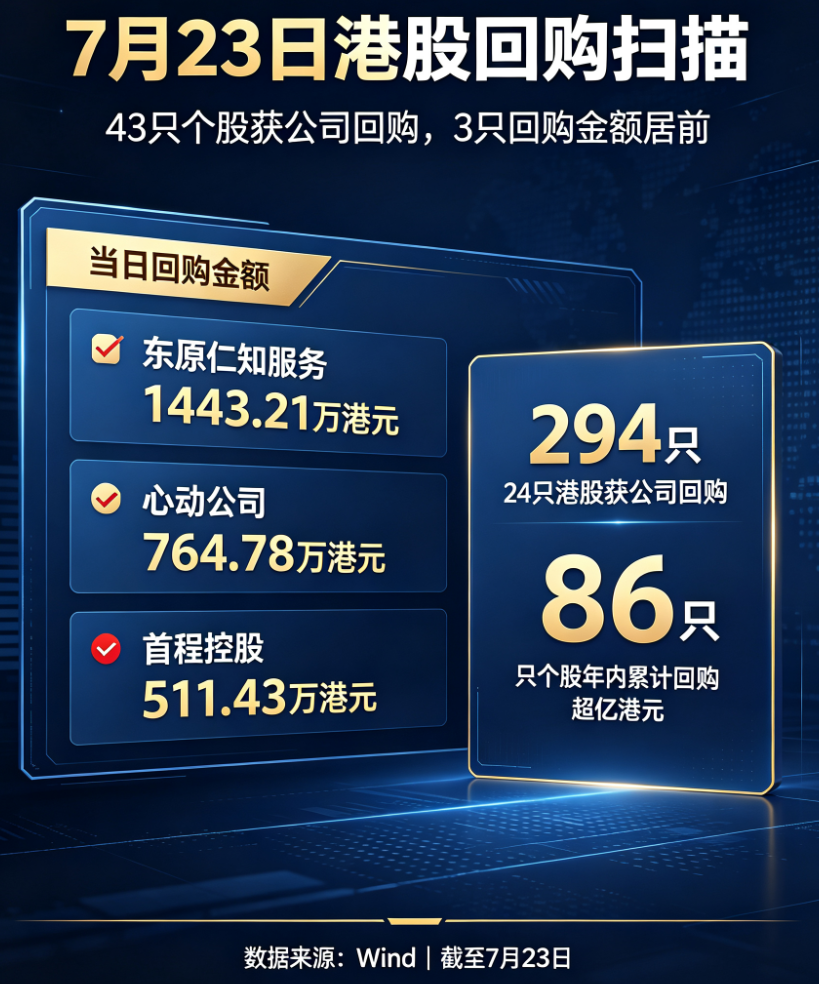
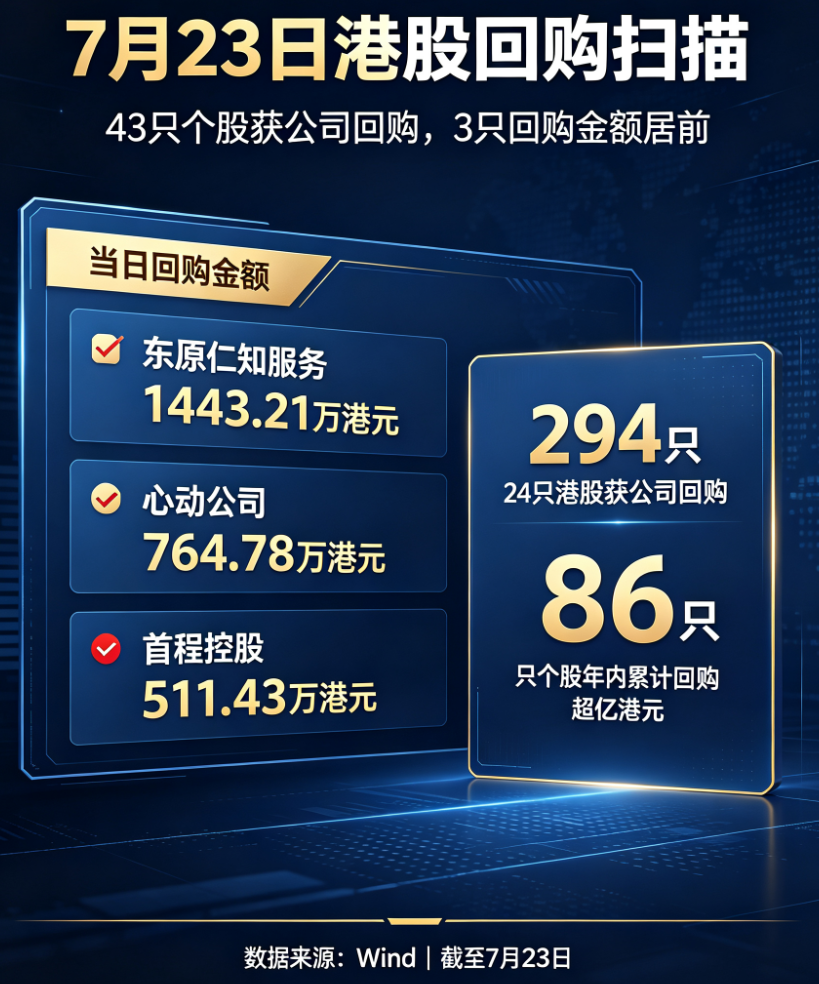
Against the backdrop of heightened capital market volatility, listed company buybacks are often seen as a key signal to convey confidence and stabilize stock prices. On July 23, 2026, Wind data showed that 43 Hong Kong stocks were repurchased that day, with Dongyuan Renzhi Service, XD Inc., and Shoucheng Holding leading at HK$14.4321 million, HK$7.6478 million, and HK$5.1143 million respectively. This data not only reflects listed companies' recognition of their own value but also reveals that the overall valuation of the Hong Kong stock market is at a relatively low level, with companies actively using buybacks to protect shareholder interests.
As of July 23, 2026, 294 Hong Kong stocks have been repurchased this year, and 86 have cumulative buyback amounts exceeding HK$100 million. This scale is at a relatively high level in the history of Hong Kong stock buybacks in recent years, sparking widespread discussion on valuation recovery and corporate capital operation strategies.
1. High concentration of buyback amounts, leading companies set the trend
From the buyback data on July 23, Dongyuan Renzhi Service topped the list with HK$14.4321 million, far ahead of others. This property management service provider has recently faced stock price pressure, but the company's large buyback demonstrates management's firm confidence in its business prospects. Following closely, XD Inc. (HK$7.6478 million) and Shoucheng Holding (HK$5.1143 million) are also leading players in their respective niches.
Notably, although the single-day buyback amounts seem modest, the overall trend indicates that Hong Kong listed companies' buyback activities are shifting from "sporadic" to "normalized." Especially in the first half of 2026, amid global liquidity tightening and heightened geopolitical risks, more companies are choosing to respond to market doubts with real money. Looking at cumulative data this year, 86 out of 294 stocks have buybacks exceeding HK$100 million, accounting for nearly 30%, meaning buyback activities are concentrating on quality companies, forming a "strong get stronger" pattern.
2. Buyback motivation: rational choice in undervaluation or market value management?
Listed companies typically have multiple considerations for buybacks. The most direct reason is undervalued stock prices. The current Hang Seng Index price-to-earnings ratio remains at a historically low percentile, with significant gaps between intrinsic value and market pricing for many quality companies. By repurchasing and canceling shares, companies can increase earnings per share (EPS), directly rewarding shareholders financially.
Second, buybacks are also an important tool for market value management. Compared to cash dividends, buybacks offer greater flexibility. Companies can time operations based on market conditions, avoiding the financial pressure of long-term commitments. Especially for companies with ample cash flow and low debt ratios, buybacks are akin to a "value investing" strategy—buying back their own shares at below intrinsic value and benefiting when the market recovers.
Additionally, buybacks convey management's confidence in future development. Dongyuan Renzhi Service's buyback intensity on July 23 aligns with its previously released performance guidance, indicating the company believes current stock prices do not fully reflect its earnings growth potential.
3. Impact on the market: short-term boost and long-term signal
In the short term, buybacks often provide some support to stock prices. Especially after panic sell-offs, companies stepping in to buy their own shares can act as a "safety net." On July 23, the intraday performance of these three stocks all outperformed the Hang Seng Index, showing the positive impact of buyback announcements on investor sentiment.
In the long term, sustained and large-scale buyback waves often signal the formation of a market bottom. Historically, the Hong Kong stock market saw significant increases in company buybacks during low points in 2016 and 2020. Currently, 294 stocks participating and 86 with cumulative buybacks over HK$100 million are close to historical peaks, possibly indicating a brewing value recovery rally.
However, investors must remain rational. Not all buybacks lead to stock price increases. If a company's operations deteriorate or debt is too high, buybacks may drain valuable funds, even raising concerns about financial sustainability. Therefore, when analyzing buyback activities, one should consider fundamentals, cash flow, and the cancellation ratio after buybacks.
4. Industry distribution and structural characteristics
From an industry perspective, Hong Kong stock buybacks are concentrated in information technology, healthcare, consumer goods, and property management. The property management sector, to which Dongyuan Renzhi Service belongs, has undergone a transformation from "high-speed expansion" to "refined operations" in recent years, with valuations plunging, and leading companies using buybacks to stabilize expectations. XD Inc., as a gaming and social platform, faces regulatory tightening and slowing user growth, making buybacks a key market value management tool.
Shoucheng Holding, in infrastructure and parking asset management, uses buybacks to actively deploy ample cash flow. Such companies typically have stable operating cash flow and low capital expenditure needs, making buybacks a better capital allocation method than dividends.
5. Conclusion and outlook
The continued heating of the Hong Kong stock buyback wave is a collective response from listed companies to systematic undervaluation of market valuations. As of July 23, 2026, data showing 294 stocks participating in buybacks and 86 with cumulative amounts over HK$100 million not only reflects corporate confidence but also provides an important observation window for investors.
Looking ahead, as the Federal Reserve's rate hike cycle nears its end and China's economy steadily recovers, risk appetite in the Hong Kong stock market is expected to gradually improve. In this context, buyback behavior will shift from "defensive" to "offensive," becoming a catalyst for stock price increases. For long-term investors, focusing on companies with sustained, large buybacks and solid fundamentals may yield excess returns as the market warms up.
Of course, the market does not move in one direction. Short-term factors like geopolitics and exchange rate fluctuations may still disrupt Hong Kong stock trends, but the value signal conveyed by buybacks is hard to ignore. When companies cast a "vote of confidence" with real money, rational investors should not stay on the sidelines.