


Short-Term Fluctuations Do Not Change the Long-Term Trend: Structural Opportunities and Policy-Driven New Drivers in Market Adjustment
On July 24, 2026, the A-share market experienced a significant adjustment, with the three major indices opening lower and market sentiment turning cautious. However, beneath the seemingly sluggish surface, sectors such as energy equipment and oil & gas bucked the trend and strengthened, with some stocks hitting the daily limit consecutively, indicating that structural opportunities still exist. At the same time, a series of positive news, including the State Council's release of the "National Fitness Plan (2026-2030)", the preparatory establishment of a space solar working group, and a breakthrough in EEG signal acquisition technology, injected new imagination into the market. This article will analyze the current market characteristics and possible future development paths from four dimensions: market performance, policy drivers, technological innovation, and investment outlook.
1. Market Opening: Structural Divergence and Sentiment Game
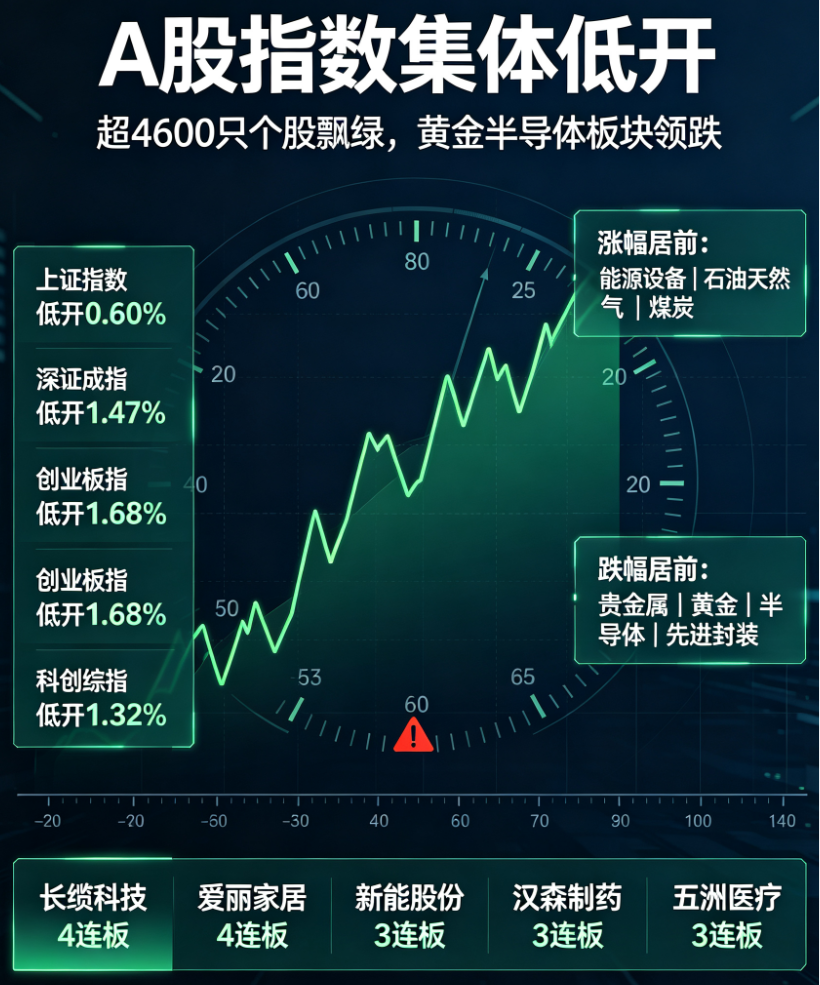
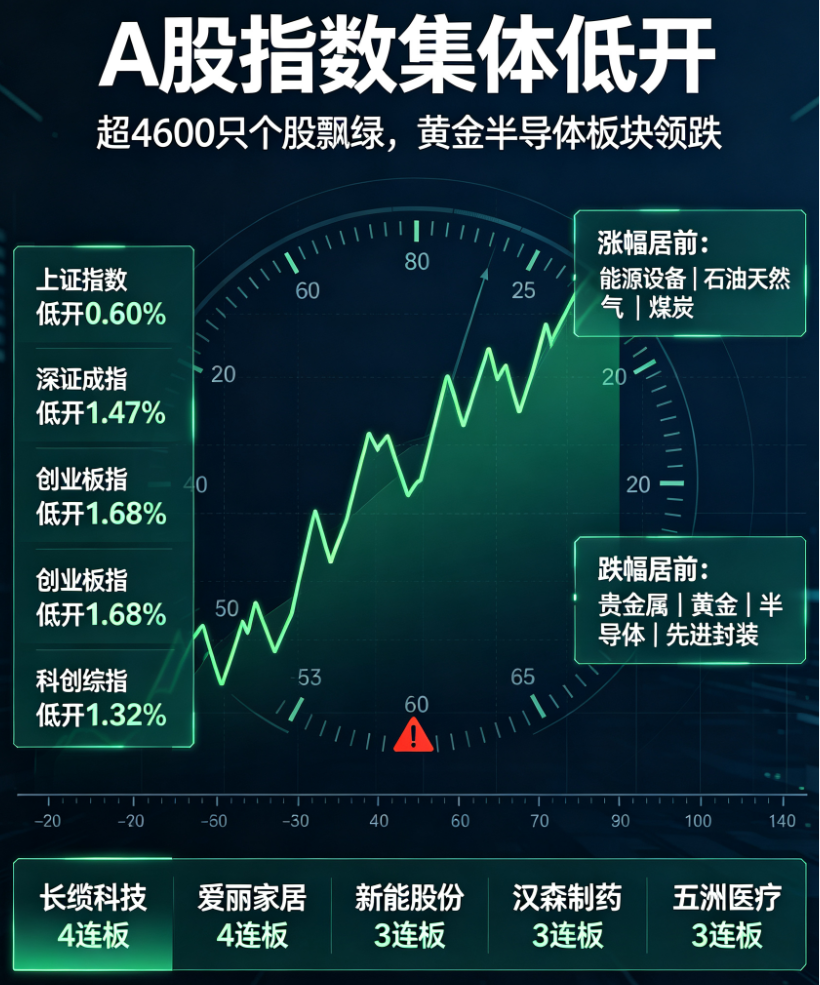
At the opening on July 24, the A-share market showed weakness: the Shanghai Composite Index opened 0.60% lower, the Shenzhen Component Index opened 1.47% lower, the ChiNext Index opened 1.68% lower, and the STAR Composite Index opened 1.32% lower. Over 4,600 stocks in the entire market were in the red, reflecting generally pessimistic investor sentiment. This round of adjustment may be affected by multiple factors, including external geopolitical uncertainties, expectations of a global economic slowdown, and local fluctuations in the pace of domestic economic recovery.
However, the market was not without bright spots. Concept sectors such as energy equipment, oil & gas, and coal rose against the trend, showing that resource sectors still have strong defensive attributes in the context of energy security and traditional energy price volatility. At the same time, sectors such as precious metals, gold, semiconductors, advanced packaging, and lab-grown diamonds led the declines, indicating that some previously high-valuation sectors with large gains are facing profit-taking pressure.
Notably, against the backdrop of overall market weakness, six stocks still hit the daily limit during the auction, among which Changlan Technology and Aili Home both achieved four consecutive limit-ups, while Xinneng Co., Hanshen Pharma, and Wuzhou Medical achieved three consecutive limit-ups. These stocks are concentrated in new energy, home furnishing, and healthcare, reflecting that market funds are seeking sub-sectors with certainty.
![A-share Market Opening Performance]()
2. Policy Drivers: National Fitness Plan Stimulates New Demand
On July 23, the State Council's issuance of the "National Fitness Plan (2026-2030)" became a market focus. The plan explicitly requires the use of artificial intelligence to empower national fitness development, emphasizing the in-depth implementation of the "AI+" action to accelerate the application of AI in fitness venues, event activities, fitness guidance, and promotion.
The introduction of this policy means that China's national fitness industry will enter a new stage of intelligent development. On the one hand, the smart transformation and upgrade of public sports venues will bring huge infrastructure construction needs, involving smart fitness equipment, digital management systems, AR/VR interaction technology, and other fields. On the other hand, the combination of online and offline mass event models will create new growth points for sports event operations, content creation, social platforms, and other industries.
From an investment perspective, the implementation of the National Fitness Plan will directly benefit smart sports equipment manufacturers, sports venue operators, fitness content platforms, and related AI technology providers. Especially under the framework of "AI+", companies capable of providing personalized services for exercise monitoring and health management are expected to gain policy dividends.
3. Technological Frontiers: Double Breakthroughs in Space Solar and Brain-Computer Interface
In the technology field, two important advances are noteworthy. First, the China Society for Materials and Testing Standardization (CSTM) plans to formally prepare for the establishment of a space solar working group, marking a key step in standardization construction in China's space solar field. The working group will conduct research on key technologies such as extreme environment testing, reliability evaluation, on-orbit verification, and system integration for space solar, promoting the standardization transformation and industry application of advanced technologies.
As a key energy technology for future deep-space exploration and space base construction, the importance of standardization work for space solar is self-evident. Currently, there is still a standard gap in this field in China. The establishment of this working group will help concentrate industry resources, accelerate technology iteration and industrialization. For related listed companies, those participating in the formulation of space solar standards may gain a first-mover advantage in technological competition.
Second, according to CCTV Finance, on July 22, a Chinese research team released a new type of EEG signal acquisition device, achieving for the first time globally synchronous EEG signal acquisition from thousands of people across regions. This breakthrough marks a critical step in neural large model training and general brain-computer interface technology R&D. Brain-computer interface technology is regarded as a core direction of next-generation human-computer interaction, with broad application prospects in medical rehabilitation, intelligent control, entertainment, and education. This technological breakthrough will accelerate the transition of brain-computer interfaces from the laboratory to commercial applications, and related concept stocks are worth long-term attention.
4. Investment Outlook: Oversold Recovery and Structural Opportunities Coexist
Facing the short-term market adjustment, a research report from CITIC Securities provides a relatively rational analytical perspective. The report points out that since July, the technology sector has undergone significant adjustment, and valuations of related targets have dropped notably. However, the fundamentals of directions such as independent controllability, AI components, price-increase chain, and consumer electronics have not reversed. Some sub-sectors' current valuations have not yet fully reflected subsequent order growth, continued price increases, and earnings realization expectations, leaving ample room for oversold recovery.
Specifically, the upward inflection point in performance for domestic semiconductor equipment and domestic computing power has become clearer. Driven by sustained global AI demand, the supply-demand prosperity of PCB, memory, AI power supply, and other segments will remain high. The AI industry chain is expected to gradually spread to the consumer electronics field, and the intelligent upgrade of smartphones, wearables, and other products will bring new growth opportunities for related supply chain companies.
In Hong Kong stocks, the Hang Seng Index opened 1.1% lower, the Hang Seng Tech Index fell 1.86%, and the State-owned Enterprises Index fell 1.13%. Internet and technology stocks led the declines, with Alibaba falling nearly 3%. The adjustment in Hong Kong's technology sector is linked to the A-share market, but against the backdrop of enhanced valuation attractiveness, medium- to long-term allocation value is gradually emerging.
5. Conclusion: New Landscape Driven by the Dual Engines of Policy and Technology
In summary, the current adjustment in the A-share market is more the result of short-term sentiment disturbance and structural rotation, rather than the release of systemic risk. From a policy perspective, favorable policies such as the National Fitness Plan and space solar standardization provide long-term growth momentum for related sectors; from a technology perspective, breakthroughs in brain-computer interfaces, artificial intelligence, and other technologies continue to expand industry boundaries, bringing new imagination space to the market.
For investors, during the market adjustment process, they should pay more attention to policy certainty and technology growth. Traditional energy sectors still have allocation value under the energy security logic, while technology sectors such as semiconductors, domestic computing power, and consumer electronics, after valuation digestion, present oversold recovery opportunities that are worth seizing. Although Hong Kong's technology sector faces short-term pressure, in the long run, with the continuous enrichment of AI application scenarios, the sector's growth potential cannot be ignored.
In short, short-term market fluctuations do not change the long-term positive trend. Driven by the dual engines of policy and technology, China's capital market is undergoing a profound transformation from "quantity" to "quality", and structural opportunities will emerge endlessly. Investors need to be patient, select targets carefully, and seek certainty amid volatility to take the initiative in the future market.
