


As a professional content creator, I will write a structurally complete and detailed market analysis article based on the reference content you provided, combined with professional analysis and insights.
Hong Kong Stock Market Divergence Intensifies: Energy & Finance Prop Up, Chips & Tech Under Pressure
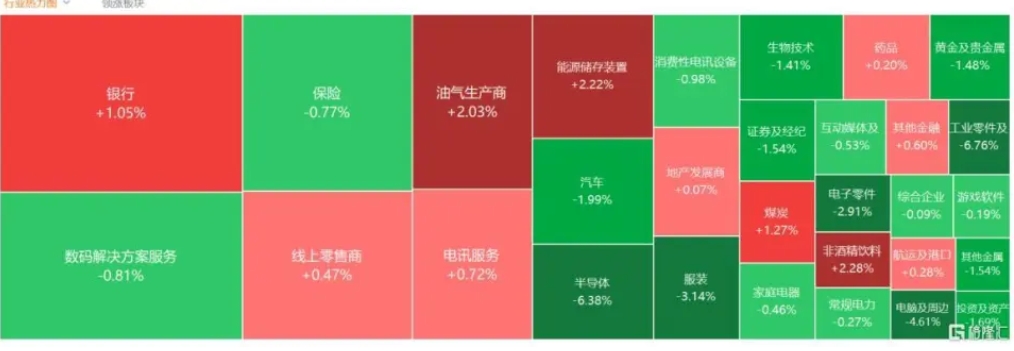
On July 13, 2026, the Hong Kong stock market presented a complex and divergent picture. Against a backdrop of persistent macro uncertainty, capital flows between sectors accelerated, leading to a "fire and ice" dramatic market. On one hand, traditional heavyweight sectors such as oil and mainland bank stocks performed strongly, effectively supporting the broader market; on the other hand, tech sectors represented by semiconductors, optical communications, and AI applications faced heavy selling, especially affected by the plunge in Korean chip stocks, with market sentiment turning cautious. This structural divergence clearly outlines the current market's oscillation between risk appetite and defensive logic.
I. Heavyweight Sectors: The "Ballast" Effect of Energy & Finance
On today's board, traditional heavyweight stocks played the role of "anchor." Mainland bank stocks generally performed strongly, with ICBC (01398.HK) rising 2.55%, reflecting risk-off preference for high-dividend, low-valuation sectors. Meanwhile, among the "three barrel oil" stocks, PetroChina (00857.HK) and CNOOC (00883.HK) also recorded different gains. The strength of energy stocks, besides being supported by stabilizing international oil prices, is also due to their stable cash flow and dividend capacity, which are particularly precious in the current market environment.
Additionally, in the consumer and real estate sectors, catering stocks, lithium battery stocks, Chinese medicine stocks, and mainland property stocks generally rose. This indicates that despite pressure on tech growth stocks, sectors benefiting from domestic demand recovery expectations or policy support still gained some capital favor. However, the tech giant camp showed divergence: e-commerce giant JD.com (09618.HK) rose 2.7%, but Baidu (09888.HK) and Meituan (03690.HK) both fell about 1%, and Tencent (00700.HK) also closed slightly lower. The divergence among heavyweights suggests market differences in valuation and future growth paths of tech leaders.
II. Chip & Tech Stocks: Korean Storm Hits HK, Sector Bleeds Heavily
In stark contrast to the stability of heavyweight sectors, the tech sector suffered a heavy blow today, with the core trigger coming from the Korean market.
1. Semiconductor Sector "Avalanche"
The plunge sentiment in Korean chip stocks quickly transmitted to the HK market. This not only caused the leveraged ETF "2x Long SK Hynix" to crash over 33%, but also directly led to HK-listed semiconductor leader GigaDevice (603986.SH) falling over 15%. Market concerns about the global memory chip cycle peaking and earnings pressure on Korean leaders were sharply amplified. This crash exposed the high dependence and vulnerability of HK's semiconductor industry chain on external markets, with investor panic over supply-demand reversal reaching a seasonal peak.
2. Chain Reaction: Optical Comms & PCB
The panic did not stop at semiconductors but quickly spread downstream along the industry chain. Optical communication concept stocks and PCB concept stocks also fell sharply today. Kingboard Group (00148.HK), as industry leader, saw its stock plummet over 19%, and YOFC (06869.HK) fell over 12%. This indicates market fears that weak terminal demand will gradually transmit upstream, leading to earnings downgrade risks across the entire electronics chain. This chain reaction of "all for one, one for all" highlights the vulnerability of current tech stock pricing logic.
III. Rapid Sector Rotation: Military & AI Application Adjustments
Another notable signal is that previously active thematic sectors saw significant profit-taking today.
Military stocks, which surged last Friday, generally corrected today, consistent with the "hot topic one-day rally" feature, reflecting rising risk-off sentiment among short-term capital. At the same time, the previously sought-after AI application concept stocks and application software stocks also weakened collectively. Against the backdrop of heavy losses in underlying hardware like chips, the market began to reassess the pace and cost of AI application deployment. When expectations of declining hardware costs are interrupted by short-term shocks, the valuation logic of downstream application sectors also faces challenges. This phenomenon reminds investors that in a high-volatility market, chasing momentum carries great risk, and sector rotation is extremely fast.
IV. Market Outlook: Attack and Defense in Structural Market
Looking at today's trading, the HK stock market is at a critical "watershed" stage. On one hand, high-dividend, low-valuation traditional sectors (energy, banks) act as a market safety cushion, attracting low-risk capital; on the other hand, tech growth sectors like semiconductors and AI, though long-term logic unchanged, face multiple short-term pressures from overseas market volatility, industry cycle changes, and profit-taking.
Looking forward, investors need to closely monitor several key variables:
- External market linkages: especially performance of major chip markets like Korea and US, which will be the core variable determining short-term direction of HK tech stocks.
- Capital flows: observe dynamics of northbound and southbound funds to judge whether capital is "risk-off" or "bottom-fishing," confirming if market style will fully shift.
- Fundamental verification: the upcoming earnings season will be key to testing the quality of each sector. Whether earnings meet expectations will directly determine if the current divergence persists.
In the current environment, the market assigns a high premium to "certainty." For investors seeking stability, continuing to hold or allocate to "cash cow" companies with strong cash flow and dividend capacity remains an effective strategy to hedge market uncertainty. For those bullish on tech growth, patience is needed, waiting for external risks to subside and industry negatives to clear before selectively positioning in targets with core tech barriers and digested valuations.
In summary, the trading on July 13 was a concentrated outbreak of the market's internal structural contradictions. It is both a release of risk signals and an indication of future market direction. Only by staying calm amid the noise and rationally analyzing the driving logic behind sectors can investors remain invincible in an increasingly divergent market.
